Emergency supply chain coordination starts before a disaster exposes gaps in demand reporting, partner communication, and delivery-point visibility. Local governments, nonprofits, NGOs, CERTs, and community leaders need a shared way to confirm what is needed. Where it is needed, who is responsible, and whether the handoff was completed.
In practice, emergency supply chain coordination connects changing needs with available supplies, partners, and distribution points. It is broader than procurement or transportation, covering the information flow and decisions that help organizations prioritize essentials such as food, water, shelter, and medical treatment.
That distinction matters because emergency logistics involve unique challenges, including uncertain timing, location, and impact. A practical approach begins by defining the coordination picture, then building repeatable processes for validation, prioritization, and accountability.
What Is Emergency Supply Chain Coordination?
Emergency supply chain coordination is the process of aligning needs, available supplies, response partners, delivery points, and updates during a disaster. It helps decision-makers answer practical questions: What is needed? Where is it needed? Who can provide it? Who is responsible for the next handoff?
Those questions matter because emergencies create uncertainty around the timing, location, and impact of both supply and demand. Relief supplies may include food, water, shelter, and medical treatment, all of which must reach affected people quickly and efficiently. The academic literature on disaster relief supply management identifies coordination as a distinct decision area alongside facility location and inventory decisions. Research on disaster relief supply management provides useful context for that distinction.
Coordination is broader than procurement
Procurement is the act of sourcing and purchasing goods. Warehousing covers how supplies are received, stored, and prepared for release. Transportation moves those supplies between locations. Inventory ownership defines who controls stock and accounts for it. Coordination connects these functions without pretending to replace them.
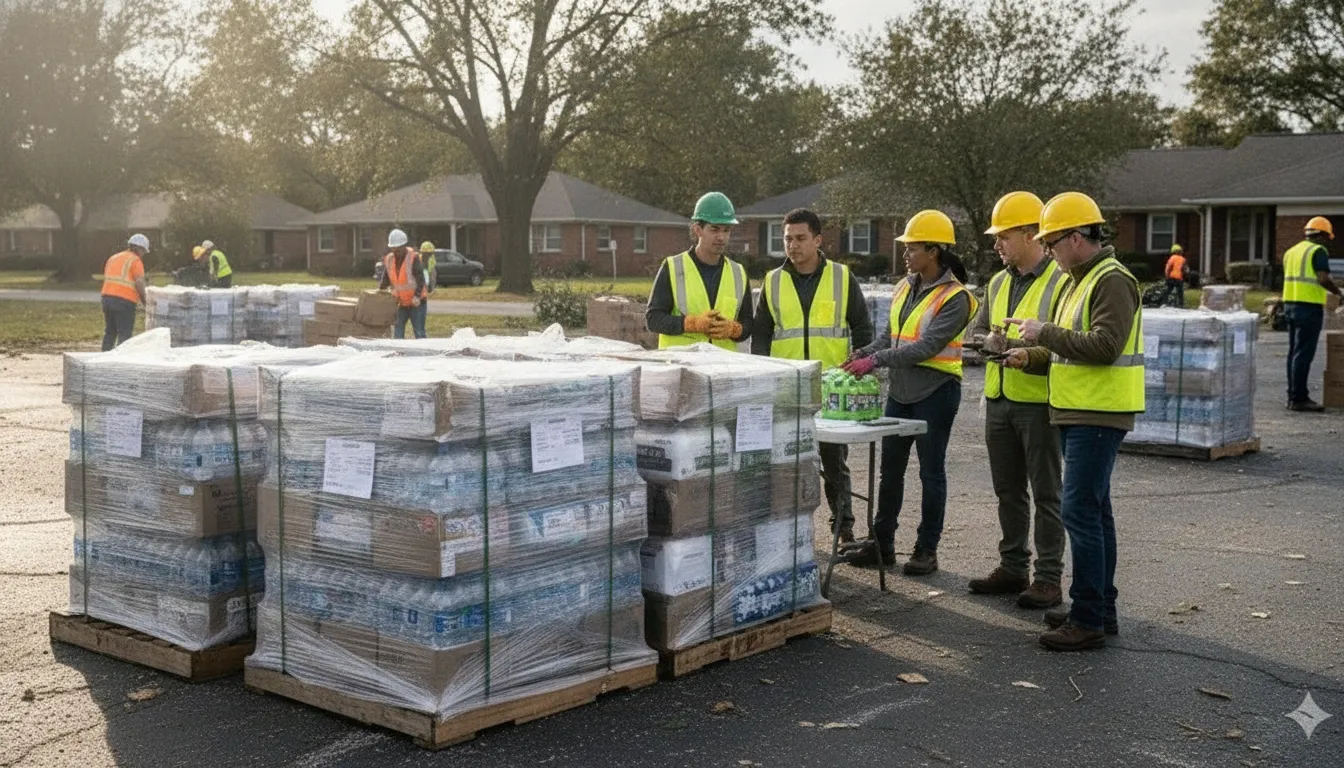
In practice, coordination can mean consolidating requests from a county, CERT, nonprofit, or faith-based group. It can include confirming whether a delivery point is open, assigning a partner to respond, recording the handoff, and sharing status with the appropriate emergency management structure. It may also identify duplication, such as multiple organizations sending the same item to one location while another community remains unserved.
FEMA describes disaster logistics and supply chain management as having unique challenges and solutions related to emergency response. That makes a shared operating picture valuable, but it does not remove the need for purchasing policies, warehouse procedures, transportation plans, or official command decisions. Organizations can use the National Response Framework overview to connect local coordination practices with established response principles.
Answer capsule: Emergency supply chain coordination aligns requests, supplies, partners, delivery points, and status updates during a disaster. It is different from buying, storing, transporting, or owning inventory. The goal is shared visibility and accountable handoffs so response organizations can direct available resources where they are most needed.
Why Does Supply Coordination Become Difficult During Disasters?
Disaster conditions disrupt the assumptions that make ordinary supply chains manageable. Demand can change faster than organizations can validate it. Roads, power, communications, staffing, and facilities may be limited. Several groups may report the same need, while other needs remain invisible because residents cannot reach a formal intake channel.
The first operational problem is incomplete or inconsistent information. One partner may report pallets, another may report cases, and a third may describe a delivery point by a local landmark rather than a verified address. Without common fields and status definitions, leaders cannot easily compare requests or know whether a need is open, assigned, en route, fulfilled, or no longer valid.
The second problem is fragmented responsibility. Suppliers, donors, government agencies, NGOs, CERTs, faith-based organizations, and community groups may all contribute. Their missions and authority differ. A coordination process must make ownership visible without implying that one organization controls every resource.
The third problem is changing access. A distribution point that was open in the morning may close because of flooding, safety concerns, staffing, or a route interruption. A request from an isolated area or a damaged neighborhood may need attention even when another area has a larger volume of requests.
These conditions make communication more than a convenience. It is an operational control. FEMA’s Lifelines Toolkit guidance describes the importance of restoring flows that communities depend on. Local organizations can translate that principle into a simple record of need, location, responsible partner, delivery status, and next update.
Build a Shared Picture of Demand and Delivery Points
A shared picture does not require every partner to use the same procurement or warehouse system. It requires a common coordination record that can be updated as conditions change. Start with the minimum information leaders need to make a safe decision.
- Need: record the requested item, quantity or scope, urgency, and supporting context.
- Location: capture the delivery point, access notes, operating hours, and a reliable contact.
- Ownership: identify the organization or person responsible for the next action.
- Status: use clear states such as reported, validated, assigned, in transit, received, or closed.
- Evidence: attach field updates, photos, messages, or confirmations when appropriate and permitted.
- Last update: show when the record was checked so stale information can be challenged.
Mapping can add useful context when it is tied to action. A map may show clusters of requests, open distribution points, access constraints, or gaps between reported needs and assigned partners. It should not be mistaken for proof that a route is passable or that an item is available. Those facts still require confirmation from the responsible partner.
Define the update rhythm before the incident. High-priority requests may need frequent checks, while stable records can be reviewed less often. Create an escalation rule for information that is missing, contradictory, or past its expected update time. The goal is not to create administrative work for its own sake. It is to keep a decision-maker from acting on an outdated record.
Local organizations can also connect supply coordination with their broader disaster response platform and incident-management practices. Keep the boundary clear: the coordination record organizes information; it does not purchase supplies or certify inventory.
How Should Response Organizations Prioritize Limited Supplies?
Prioritization should be explicit, consistent, and revisable. A simple rubric helps leaders explain why one request moved ahead of another when supplies, transport, staff, or access are constrained. The exact scoring method will vary by organization, but the decision factors should be agreed before activation.
Start with life-safety urgency
Ask whether delay could create an immediate risk to life, health, shelter, or protection. Water, medical treatment, safe shelter, and other essential needs may require rapid escalation. Record the reason for the urgency instead of relying on a vague label.
Account for vulnerability and access
Consider who is affected and how easily they can obtain help elsewhere. Older adults, people with disabilities, medically vulnerable residents, children, and households without transportation may face greater consequences from a delay. Geographic access matters as well. A request from an isolated area, a damaged neighborhood. Or a location cut off from normal distribution channels may need attention even when another area has a larger volume of requests.
Verify need and revisit decisions
Use the strongest available information before dispatching scarce supplies. Confirm the location, requested quantity, current conditions, responsible contact, and whether another organization has already fulfilled the need. Keep the record visible to authorized partners so duplicate deliveries and outdated requests are easier to identify. Local emergency managers need operational visibility, rapid communication, and accountable deployment records to adjust priorities as conditions change.
Prioritization is not a promise that every need can be met immediately. It is a transparent process for using available information responsibly. Publish the criteria to participating organizations, document exceptions, and review the queue when new demand signals or access changes appear.
Coordinate Suppliers, NGOs, CERTs, and Community Partners
Partner coordination improves when the process defines contributions and handoffs instead of assuming that every organization works the same way. Before an incident, identify likely partners, points of contact, service areas, decision authority, and the information each group can reliably provide.
| Partner | Coordination question | Record to maintain |
|---|---|---|
| Supplier or donor | What can be offered, when, and under what conditions? | Offer, quantity, timing, restrictions, contact |
| Government or EOC | Which needs and priorities are officially recognized? | Request status, priority rationale, escalation path |
| NGO or faith-based group | Which communities, services, or volunteers can it reach? | Coverage area, capacity, assignment, handoff |
| CERT or field team | What has been observed or confirmed on the ground? | Incident report, location, safety note, timestamp |
| Community contact | Is the need current and is the delivery point accessible? | Confirmation, access update, unmet need |
Use one designated owner for each next action. Shared responsibility can become no responsibility when everyone assumes someone else is following up. A named owner does not need to control the entire chain. The owner simply confirms the next update or hands the action to a named partner.
Set communication triggers for meaningful changes: a delivery point closes, a route becomes inaccessible, an offer changes, a request is fulfilled, or an urgent need is verified. Use redundant channels when the incident could disrupt internet or cellular service. PubSafe requires internet connectivity, so it should complement, not replace, radio, satellite, mesh, phone, or other offline communication plans.
For larger networks, connect supply records with a VOAD coordination workflow or mutual-aid process. Keep permissions appropriate to the information being shared, and avoid exposing personal details that partners do not need to act.
What Should a Disaster Supply Chain Contingency Plan Include?
A contingency plan should describe how the organization will continue coordinating when the preferred supplier, route, facility, channel, or staff member is unavailable. It is not a guarantee that every disruption can be avoided. It is a set of decisions and alternatives prepared before pressure peaks.
Define supply and delivery alternatives
List substitute suppliers, alternate delivery points, alternate routes, and partner organizations that may help. Establish who can approve a change and what information must be confirmed before switching. If a substitute is not available, record the unmet need and escalation path rather than marking it complete.
Set communication triggers and redundancy
Define the conditions that activate the contingency plan. Examples include a missed delivery window, loss of contact, a closed facility, route failure, or a significant change in demand. Assign who sends the update and which channels are used. Practice the handoff so the plan is familiar before an incident.
Review performance after each activation
After an exercise or real response, compare reported needs with completed handoffs. Review stale records, duplicate requests, delayed updates, unclear ownership, and access barriers. Turn the findings into a short list of changes with an owner and a due date. Continuous improvement is more useful than a plan that remains unchanged after conditions expose its weaknesses.
The U.S. Department of Transportation emergency transportation report offers additional context for planning around transportation disruptions. A local plan should still reflect local authorities, contracts, safety rules, and operational realities.
Where Does PubSafe Fit in Emergency Supply Chain Coordination?
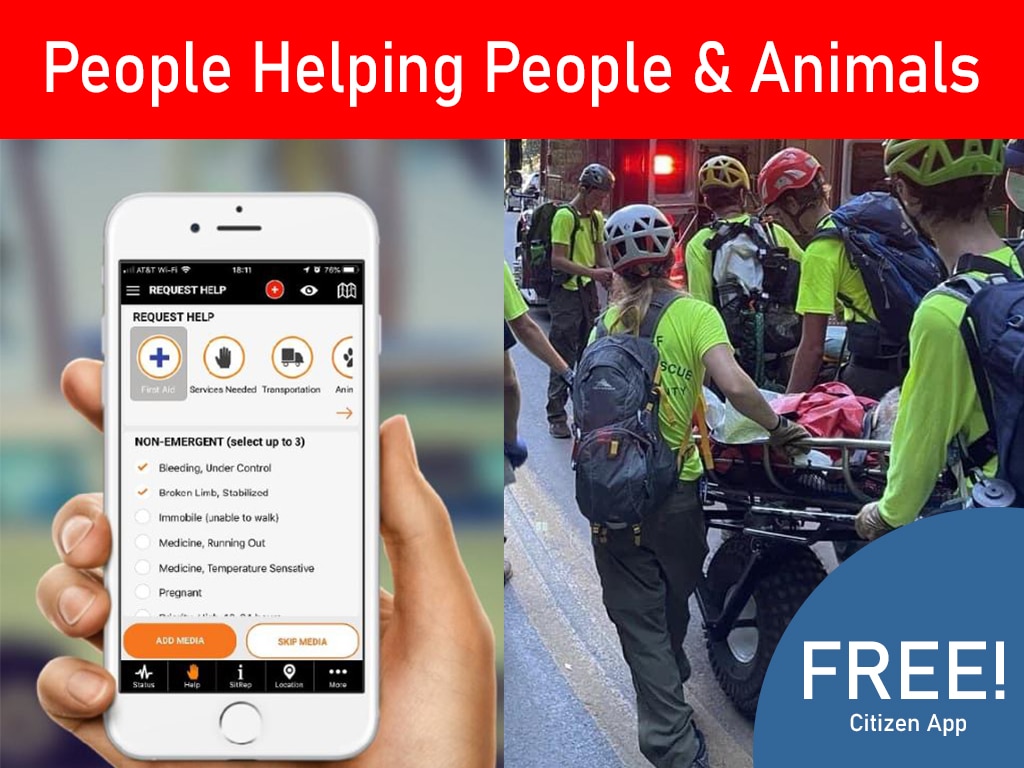
PubSafe can serve as a coordination and information-sharing layer for local response organizations that need to connect incident reports, teams, messages, maps, and resource-point updates. That can help leaders keep requests, assignments, and status changes organized across participating groups.
Its role has limits. PubSafe does not replace procurement, warehousing, transportation, inventory ownership, or official emergency management command. Partners remain responsible for acquiring, storing, moving, and confirming supplies through their established processes. The platform should support those workflows by making relevant updates easier to share and review.
Potential coordination uses include capturing a field report about an unmet need. Routing the report to an authorized team, sharing a location update, documenting a partner handoff, and reviewing response activity. Organizations can also use team and volunteer-management functions to clarify who is available and assigned, when those workflows fit their operating model.
Because PubSafe requires internet connectivity, a continuity plan should keep offline communication methods available. Radio, satellite, mesh, phone, and other channels may provide the fallback path during an outage. When service returns, authorized users can reconcile updates so the shared record reflects what happened.
For organizations considering a coordination platform, evaluate whether it supports your information model, permissions, reporting needs, mobile workflows, and partner adoption. The right system is the one people can use consistently during routine readiness work and a changing incident.
Frequently Asked Questions
What is supply chain coordination?
Supply chain coordination is the process of aligning needs, suppliers, partners, delivery points, timing, and status information so resources reach the right people with less duplication. In a disaster, those resources may include food, water, shelter, and medical treatment. Disaster relief research notes that uncertainty around timing, location, and impact makes this work especially difficult.
What does emergency coordination mean?
Emergency coordination means organizing agencies, nonprofits, CERT teams, suppliers, and volunteers around a shared operating picture and agreed responsibilities. Teams confirm needs, route information, prioritize urgent requests, communicate changes, and document handoffs while preserving official command structures. FEMA describes disaster logistics and supply chain management as having distinct challenges related to emergency response.
What are the 5 elements of an emergency response plan?
There is no single universal five-part format, but a practical plan should cover prevention and mitigation, preparedness, response, recovery, and communications. Define who activates the plan, how needs are reported, which partners own each action, how resources are prioritized, and how updates reach field teams and residents. Review the plan with partners before an incident and after exercises or real events.
What are the 7 C’s of SCM?
The 7 C’s are a useful general logistics checklist: the right product, quantity, condition, place, time, customer, and cost. During disaster response, apply the framework carefully. Life safety, equitable access, changing demand, and available delivery routes may matter more than minimizing cost, so document the criteria and revisit decisions as conditions change.
Contact us to strengthen local response coordination
When supply needs, delivery points, and partner updates change quickly, a shared coordination layer can help local response organizations keep information organized and handoffs clear. PubSafe supports coordination and information-sharing, while procurement, warehousing, transportation, and inventory operations remain with the appropriate response partners. To discuss your local disaster response needs, Contact PubSafe.