A warning is only the beginning of a safe response. When a flood, wildfire, severe storm, or other hazard threatens, communities need more than a detection feed or a mass notification. They need a clear path from verified information to decisions, assignments, movement, and feedback.
The quality of that action depends on the handoffs between agencies, responders, volunteers, and residents. Understanding the four-part framework makes it easier to identify where an alert process stops short and how a community can build a more dependable response.
What Are Early Warning Systems? Definition and the Four Pillars
Early warning systems are not simply tools for sending emergency messages. They are coordinated, end-to-end arrangements that connect knowledge about risk with hazard monitoring, public communication, and the ability to act. The goal is to help people and organizations understand what may happen, receive a credible warning, and take an appropriate step before impacts become worse.
The United Nations Office for Disaster Risk Reduction identifies multi-hazard early warning systems as a key part of comprehensive disaster risk reduction. The framework is designed to protect people exposed to different hazards, rather than treating each threat as an isolated alerting problem. That distinction matters for communities managing floods, severe weather, wildfire, hazardous materials incidents, or multiple risks across the same area.
1. Disaster risk knowledge
The first pillar establishes what a community needs to know about its hazards, exposure, and vulnerabilities. It depends on systematic data collection and disaster risk assessments, not assumptions made during an incident. Local leaders can use this knowledge to identify who may need additional support, which facilities are exposed, and what protective actions are realistic for different neighborhoods.
2. Detection, monitoring, analysis, and forecasting
The second pillar turns observations into an understanding of the hazard and its possible consequences. Monitoring may involve official forecasts, sensors, field reports, geospatial information, or other authoritative data. For hazards such as floods, tsunamis, and storm surges, current geospatial information can help model how conditions may spread inland and inform evacuation routes or temporary shelter areas. Satellite and other earth-observation data can also contribute to system design and ongoing improvement.
3. Warning dissemination and communication
The third pillar is the communication of a warning by an official source. A useful warning should be authoritative, timely, accurate, and actionable. That means people should be able to understand the hazard, the area affected, the timeframe, and what they are expected to do. A notification channel can support dissemination, but the broader system must preserve the connection between verified information and clear public guidance. See how mass notification versus community alerts can represent different parts of that communication challenge.
4. Preparedness and response capabilities
The fourth pillar determines whether a warning can lead to action. Preparedness must exist at every relevant level, from households and facilities to municipalities, CERTs, NGOs, and response agencies. Plans, assignments, access to resources, and practiced procedures turn an alert into evacuation support, welfare checks, shelter operations, or other protective work. Without this pillar, even an accurate warning may arrive without a workable next step.
How Do Early Warning Systems Move From Detection to Action?
An alert is only useful when it leads to a timely, coordinated decision. The operational path should connect hazard information with the people, resources, and assignments needed to reduce harm. The World Meteorological Organization describes multi-hazard warning systems as integrated systems that inform governments, communities, and individuals both that a hazardous event is approaching and how to act. Early warnings and early action can save lives, but only when the handoffs are clear.
- Monitor the hazard and identify exposure. Detection begins with observing conditions, analyzing the hazard, and forecasting possible consequences. Risk knowledge and current geospatial information help responders understand which neighborhoods, facilities, roads, or vulnerable groups may be affected. This stage should establish what is known, what remains uncertain, and which threshold requires escalation.
- Verify the information and authorize the warning. Before a message is distributed, the responsible authority should confirm the source, assess the evidence, and determine the level of urgency. Verification does not mean waiting for perfect information. It means applying a defined decision rule, documenting the basis for action, and assigning an accountable official or agency to approve the warning.
- Design a message people can use. The warning should state what happened or may happen, who is at risk, where and when impacts are expected, and what recipients should do next. Use plain language, specific locations, and a clear deadline or trigger when one is known. Official warnings should be authoritative, timely, accurate, and actionable, as outlined by the United Nations Office for Disaster Risk Reduction.
- Disseminate through appropriate channels. Select channels based on the audience, hazard, reach, accessibility needs, and likely infrastructure conditions. A coordinated emergency alert app for small towns can complement official warning channels by helping local teams organize audience-specific communication. The goal is not simply to send more messages. It is to reach people where they are likely to receive and understand the warning.
- Confirm receipt and assign responsibilities. A warning should create an operational record of who acknowledged it and which team owns each next step. Municipal departments, CERT members, NGOs, facility managers, and partner agencies may need different assignments. A shared emergency communication plan template can define these roles before an incident, reducing confusion during the handoff.
- Move from assignment to field action. Teams then carry out the prepared response, such as checking on exposed residents, opening a shelter, supporting evacuation, protecting critical assets, or reporting changing conditions. The action should match the warning, available resources, and local operating procedures. Prepared and tested capabilities make the difference between an instruction that is technically correct and one that is feasible under pressure.
- Collect feedback and update the picture. Field reports, unanswered acknowledgments, changing hazard conditions, and community questions should return to the coordination team. That feedback can trigger a revised warning, a new assignment, or an escalation. This closes the loop and turns a one-way alert into an end-to-end process that improves situation awareness as conditions evolve.
Where Do Alert-to-Action Handoffs Break Down?
An alert is not the same as an action. The handoff succeeds only when the right people receive a clear message, understand their responsibility, acknowledge it, and report what happened next. When any of those steps is missing, an early warning systems program can look active on paper while leaving a community unsure what to do.
Unclear ownership turns urgency into delay
Messages often move through several layers: an authority detects a hazard. An emergency manager validates the situation, public information staff shape the message, and field teams carry out assignments. If ownership is not defined at each transition, people may assume someone else is monitoring the situation or contacting the next group. A practical handoff names the sender, decision owner, recipient, deadline, and expected action.
One message cannot serve every audience
A warning may be technically accurate but still fail if residents, volunteers, partner organizations, and field personnel receive the same wording without useful context. Residents need a direct protective action. A CERT team may need an assignment, location, and reporting channel. An NGO may need to know which population requires assistance. Messages should also account for language, accessibility, device limitations, and people who are offline or outside the primary communications channel.
Fragmented channels hide the operational picture
Phone trees, email, text messages, radio traffic, social platforms, and separate responder apps can all have a role. The gap appears when updates are scattered across systems and no one can tell which version is current. This is why it helps to distinguish mass notification versus community alerts. One-way distribution can spread a warning, but coordinated response also needs a way to organize replies, assignments, and updates.
No acknowledgment loop means no confidence
Delivery does not prove comprehension, and comprehension does not prove action. Every critical handoff should have a defined acknowledgment or escalation path. If the assigned person cannot respond, the system should make that visible so a supervisor can reassign the work rather than wait silently.
Weak field reporting breaks the feedback loop
Without concise field reports, decision-makers may not know whether an evacuation route is usable, a shelter is ready, or a vulnerable group has been reached. Reporting does not need to be elaborate. It needs a consistent format for status, location, needs, and next step. Reviewing these gaps during exercises and after incidents helps turn warnings into tested, repeatable action.
How Municipalities, CERTs, and NGOs Turn Alerts Into Assignments
An alert only becomes useful when someone owns the next action. Municipalities, community CERTs, NGOs, and local safety coordinators each see a different part of the incident. A coordinated workflow makes those perspectives work together instead of leaving the public with a message but no clear path to help.
Municipalities and EOCs set priorities
The municipality or emergency operations center typically confirms the operational picture, identifies affected areas, and establishes priorities. After an official warning, an EOC might assign staff to verify reports near a flooded roadway. Request a welfare check for a vulnerable resident, or coordinate shelter and transportation information with partner agencies. Its responsibility is not to perform every field task. It is to define objectives, establish ownership, and maintain a reliable view of what has been reported and resolved.
That requires a handoff from public information to operations. An alert can tell residents what hazard is occurring and what protective action to take. The EOC then needs a way to receive structured reports, route them to the right organization, and track status. This is where emergency operations center software can support the connection between command decisions, partner agencies, and field information.
CERTs convert local knowledge into field action
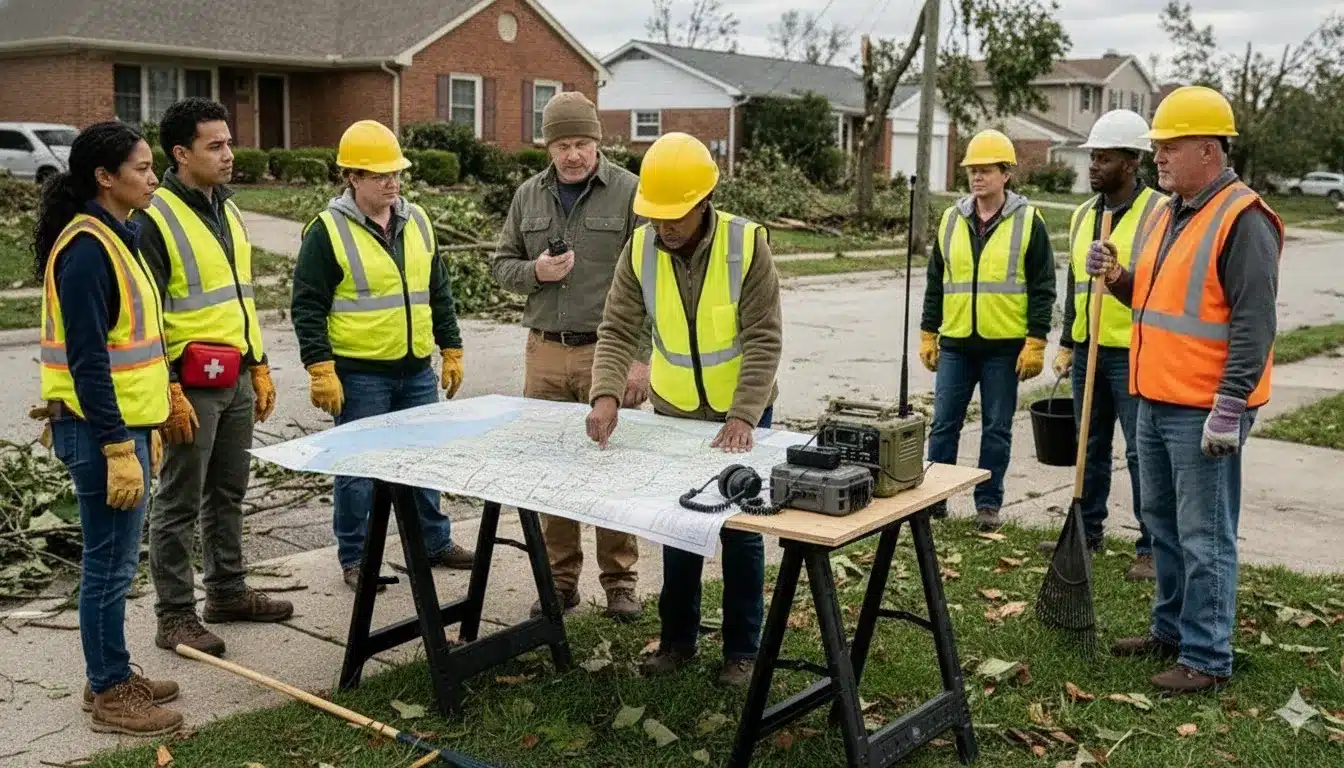
Community Emergency Response Teams can translate a broad municipal priority into specific, bounded assignments. A CERT coordinator might activate trained volunteers to conduct a neighborhood check, document visible damage, support an information point, or report blocked access routes. Each assignment should include a location, task owner, safety limits, reporting method, and completion status. The coordinator can then escalate conditions that exceed volunteer capabilities instead of sending unstructured updates through separate text threads.
Preparedness is part of this role. The United Nations Office for Disaster Risk Reduction describes preparedness to respond as one of the interrelated elements of an effective early warning system. Municipal leaders can support that element through emergency preparedness software for CERTs that keeps activation and communication workflows ready before an alert arrives.
NGOs fill service and support assignments
NGOs often bring specialized capacity, such as food distribution, shelter support, spiritual care, outreach, transportation, or assistance for people with limited mobility. Rather than assigning every group the same mission, a safety coordinator can match the need to the organization with the appropriate people, resources, and access. An NGO partner may receive a task to confirm shelter supply levels, while another organization checks on residents who need transportation.
That division reduces duplicated effort and creates clearer accountability. It also makes the role of NGO disaster response partners visible within the broader response picture. Participatory planning and whole-of-society support are recognized as important to making warning systems trusted and actionable, not merely capable of sending messages.
- Detection and verification: What is happening, and who confirms it? The owner is the authorized monitoring or emergency management authority.
- Warning communication: Who needs to know, and what should they do? Public information and alerting teams own this stage.
- Assignment and action: Who carries out the next protective step? An EOC, CERT, NGO, or partner team owns the assignment.
- Feedback and escalation: What changed, and what needs reassignment? The coordination lead and field teams close the loop.
Designing Early Warning Systems for Resilient Community Response
Resilience is not created by adding another notification channel. It comes from designing the entire path from warning to verified action so that one failed handoff does not stop the response. Start by mapping who needs to know, what they need to do, and how the organization will confirm that the action occurred.
Use layers rather than a single point of failure. Pair official alerts with channels that reach the people responsible for local action, such as team messaging, phone trees, radio, email, or in-person contact. The right mix depends on the hazard, geography, audience, and available infrastructure. A layered design should also identify what remains usable when power, cellular service, internet access, or a primary platform is unavailable.
Make every message accessible and actionable
A warning should answer the questions a recipient has under pressure: What is happening? Where is it happening? What should I do now? When will the next update come? Use plain language, translated versions where needed, and formats that work for people with different access needs. Keep templates modular so the sender can insert the hazard, location, protective action, deadline, and authoritative source without drafting from scratch.
Templates should support the distinction between informing people and assigning work. A public message may direct residents to shelter or avoid an area. An internal message may assign a welfare check, open a shelter, verify a road closure, or relay conditions from the field. Both need an owner and a time for the next review.
Define ownership, acknowledgment, and escalation
Before an incident, name the person or team responsible for approving each message, distributing it, monitoring replies, and escalating non-response. A delivered message is not the same as a completed action. Track acknowledgments where practical, set a reasonable response window, and define what happens when no one confirms receipt. Escalation may move to a backup contact, supervisor, partner agency, or field team.
Exercise the process under realistic constraints. Test an alternate channel, an outdated contact, a power loss, and a network outage. After each exercise or incident, record what was delayed, which audience was missed, and where ownership became unclear. Update templates, contact paths, and fallback procedures while the lessons are still specific. An emergency communication plan template can help teams document these decisions in one working reference.
What Role Can PubSafe Play After an Alert?
An official warning tells people that a hazard may affect them and what immediate action to consider. It does not, by itself, create a shared operating picture or assign the next task. PubSafe fits in that space as a coordination layer after authoritative detection and alerting. It is designed to complement existing public safety, CAD, 911, and incident command systems, not replace them.
That distinction matters when evaluating early warning systems. PubSafe does not determine whether a warning should be issued, and it does not guarantee that every person will receive a message. Instead, once an alert or incident is confirmed, teams can use the platform to connect public agencies, citizens, community CERT volunteers, NGOs, and other response partners around the work that follows.
Turning incoming information into a shared picture
PubSafe supports incident reporting through a structured workflow. A report can include a location, category, severity, description, and photo or other media. Relevant organizations can receive the report, review it, and track its status through resolution. This gives coordinators a way to collect ground-level information alongside official data, rather than relying only on disconnected calls, texts, email threads, or social posts.
Its mapping and situational-awareness features can bring together incident reports, member locations, resource overlays, weather radar, and alert layers from sources such as IPAWS, USGS, and the National Weather Service. The value is not a promise that one map will answer every operational question. The value is a common place to review available information, identify needs, and decide which organization should act.
Activating people and coordinating resources
After an alert, a municipality may need to route reports to the right department. A community CERT may need to activate trained volunteers, and an NGO may need to organize outreach or supplies. PubSafe supports team messaging, one-to-one communication, mass broadcasts, situation reports, and priority alerts with geofencing capabilities. Multi-organization membership, location-sharing controls, volunteer-hour tracking, and dynamic team formation can help leaders organize participation as conditions change.
For teams building this workflow, a disaster response platform should be evaluated against the handoffs it needs to support: report, classify, route, activate, update, and resolve. PubSafe is intended to bridge the gap between emergency alerts and real-world response, while established authorities retain responsibility for hazard detection, official warnings, and command decisions.
Frequently Asked Questions
What are the four pillars of an early warning system?
The four pillars are disaster risk knowledge; hazard detection, monitoring, analysis, and forecasting; warning dissemination and communication; and preparedness and response capabilities. They work together, so an accurate forecast still has limited value if residents do not receive a clear warning or organizations are not ready to act. The World Meteorological Organization identifies these four pillars.
What should happen after an official warning is issued?
Translate the warning into specific assignments, confirm who owns each task, and communicate the expected action to affected people. Municipal teams may activate operations, CERTs may support welfare checks or neighborhood communication, and NGOs may help with shelter, supplies, or vulnerable populations. Establish feedback channels so field teams can report changing conditions and unmet needs.
How can municipalities make alerts more actionable?
Use an authoritative source, state the hazard and affected area, explain the immediate action, and include timing, routes, or shelter information when relevant. Messages should be accessible through channels residents use and should account for language, disability, connectivity, and power limitations. Test the handoff from alert issuance to field action before an incident.
What is the role of CERTs and NGOs in early warning systems?
CERTs and NGOs extend the reach of official warnings and help convert public guidance into local action. They can support preparedness education, relay verified updates, identify people who need assistance, assist with evacuation or shelter operations, and report conditions back to municipal coordinators. Their responsibilities should be agreed in advance rather than improvised during a crisis.
How often should an early warning workflow be reviewed?
Review it after exercises, real incidents, major changes in hazards or population, and any communication failure. Check whether detection, verification, dissemination, assignments, and feedback worked as intended. Update contact lists, escalation rules, accessible message formats, backup channels, and role assignments, then test the revised workflow with the participating organizations.
Ready to strengthen your community response workflow?
Clear handoffs after an alert can help municipalities, CERTs, NGOs, and local safety coordinators move from notification to coordinated action. PubSafe can help you discuss a workflow that fits your response structure and keeps the next steps visible to the people responsible for them.
Start with a conversation about your next response workflow.