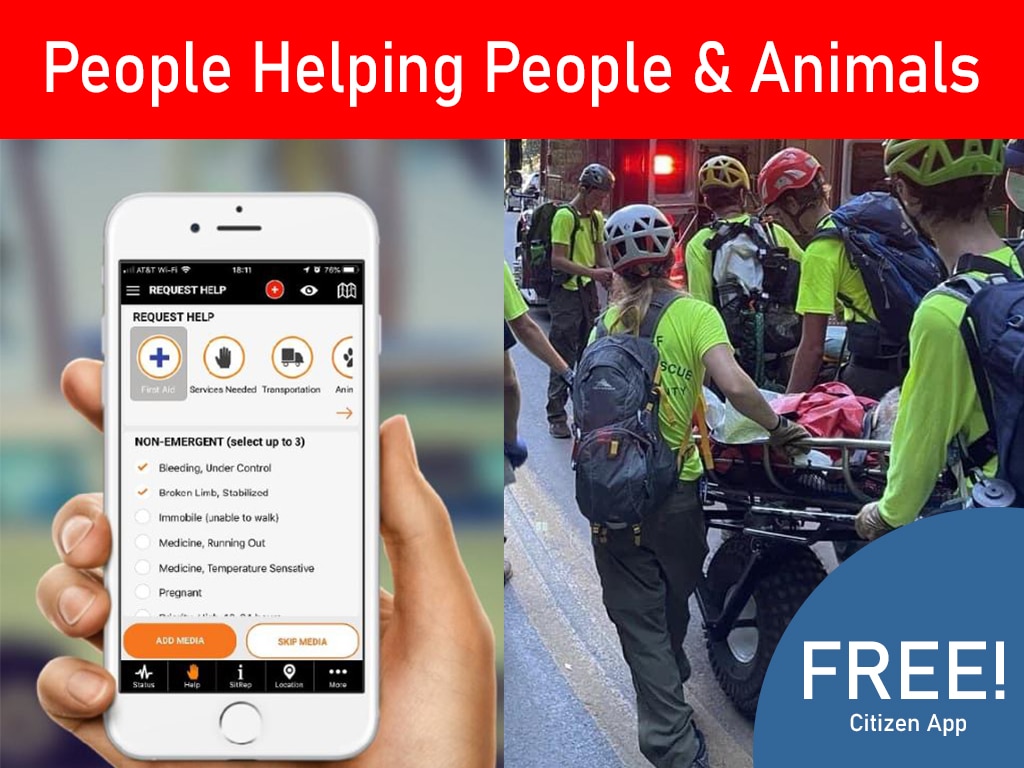
When the power goes out, most people grab a flashlight and wait. But when the grid stays down for hours or days, something far more critical fails: communication. Cell towers lose backup power, internet routers go silent, and the coordination systems that emergency teams depend on vanish. For Community Emergency Response Teams (CERTs), nonprofit response organizations, and local emergency managers, this is not an inconvenience. It is an operational crisis. To maintain emergency communication during power outages, teams need a strategy that goes beyond cellular. PubSafe’s disaster response platform provides the unified coordination layer teams need when infrastructure fails.
Maintaining emergency communication during power outages is one of the hardest challenges in disaster response. Without a deliberate strategy, teams scatter, resources go untracked, and situational awareness collapses. This guide covers the specific failure modes, the CERT communication tools that actually work when the grid is down, and how to build a communication plan that holds through extended outages.
Why Power Outages Break Modern Communication
Most emergency communication plans assume the cellular network will be available. That assumption is dangerous. Here is what actually happens to communication infrastructure during a power outage:
Cell towers have backup batteries, but not for long. Most towers carry four to eight hours of backup power. After that, they go silent unless refueled or recharged. During Winter Storm Fern in January 2026, some Tennessee households went over six days without electricity, as tracked by PowerOutage.us. Six days without cellular infrastructure in many areas. This reality has serious implications for emergency response. When a CERT team deploys into a neighborhood with no cell service, every function that depends on real-time data breaks. Team leaders cannot see member locations. Status updates do not arrive. Requests for supplies or medical assistance go unheard. The entire coordination system that teams train for becomes a collection of isolated individuals rather than an organized unit.
Internet infrastructure fails with the grid. Fiber optic lines themselves do not need power, but the amplifiers, switches, and routers that make them work do. When those fail, VoIP services, email, and app-based communication platforms become unavailable. For CERT team leaders and emergency managers, the implication is clear: to maintain emergency communication during power outages, you must plan for all three failure layers simultaneously. Successful teams build overlapping pathways so that when one layer fails, another takes over without missing a beat.
Cellular networks get congested before they fail. Even towers that remain operational quickly become overwhelmed. During Hurricane Helene, 4.79 million customers lost power at the storm’s peak in the Southeast. The surge of calls, texts, and data from those trying to reach loved ones and responders saturated the remaining network capacity.
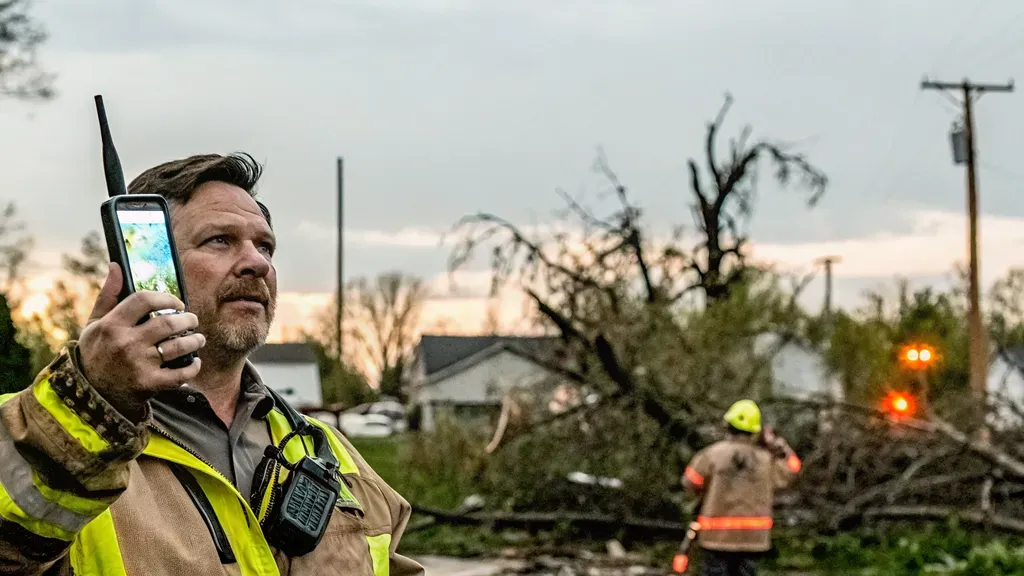
These three layers of failure mean that any communication strategy relying solely on cellular or internet-connected tools will break during an extended outage. CERT teams and emergency managers need a layered, offline-capable approach. Here is why every CERT team and emergency manager should prioritize building a robust offline communication strategy before the next disaster strikes.
How to Maintain Emergency Communication During Power Outages: The Three Failure Modes
Understanding the specific failure modes helps teams build the right redundancies. There are three distinct breakdowns that occur during a grid-down scenario:
Infrastructure Failure
Towers, switches, and cable head-ends lose power. This is a physical outage that takes hours or days to restore depending on damage and priority. Teams that assume cellular data will work on day two of a blackout will find themselves cut off.
Network Congestion Failure
Even when infrastructure holds, the network becomes unusable due to traffic. Emergency calls get queued. Text messages deliver hours late. Data sessions time out. This happens within minutes of a major event, well before batteries die.
Coordination Fragmentation
Different teams adopt different fallback tools. One group uses GMRS radios. Another uses a mesh messaging app. A third falls back to runners and paper. Without a pre-planned common operating picture, teams fracture into isolated pockets that cannot share information or requests for help.
Most teams plan for the first failure. Very few plan effectively for the second and third. The difference between a chaotic response and a coordinated one is whether the team has a unified layer that ties their disparate tools together.
What Communication Tools Actually Work When the Grid Is Down?
The options for off-grid communication fall into several categories, each with trade-offs in range, power requirements, ease of use, and coordination capability.
The emergency management software market is projected to grow from $2.8 billion to $7.6 billion by 2033. This rapid growth reflects the increasing frequency of extreme weather events and the critical need for better coordination tools. CERT teams and emergency managers who invest in resilient communication infrastructure now will be positioned to respond effectively when power outages strike their communities.
| Tool | Range | Power Required | Coordination Capability |
|---|---|---|---|
| FRS/GMRS Two-Way Radios | 1-5 miles | Batteries (replaceable) | One-to-one or group (channel-based) |
| Amateur (Ham) Radio | Local to global | Batteries or generator | Voice and digital message relay networks |
| Satellite Messengers (Garmin inReach, Zoleo, Starlink Mini) | Global | Internal battery (days) | Text and GPS location sharing; one-to-many with coordination platform |
| Mesh Messaging Apps (goTenna, Beartooth, Meshtastic) | 1-5 miles per node | Battery (hours to days) | Group text, location sharing; no infrastructure needed |
| Offline-First Mobile Apps (PubSafe) | As available | Device battery | Team coordination, incident reporting, status updates |
Each tool has a role, but none of them is a complete solution on its own. Radios provide voice but no data. Satellite messengers provide text but no team-wide situational awareness. Mesh networks provide local coverage but no connection beyond the node cluster. The real challenge is not picking one tool. It is integrating all of them into a single operational picture, which is why a comprehensive communication strategy requires multiple coordinated layers.
How to Build a Resilient Communication Plan for Extended Outages
A resilient communication plan does not depend on a single tool. It provides layers of redundancy, with each layer backing up the one above it. Here is the framework that CERT teams and emergency managers should build before the next outage. Follow these five steps to maintain emergency communication during power outages:
- Establish a primary coordination platform. Choose an offline-capable coordination platform that your whole team can use. It should provide incident reporting, member location tracking, status updates, and team messaging. The platform must work on mobile devices with cached data, syncing when connectivity returns. PubSafe provides this capability, allowing teams to continue coordinating even when cellular data is unavailable.
- Deploy two-way radio as the voice backbone. Every team member should have access to an FRS or GMRS radio as a minimum. CERT teams advancing to ham radio licenses gain access to regional and national emergency communication networks. Designate a primary and backup radio frequency before any deployment.
- Add text-only channels for low-bandwidth situations. When voice channels are congested, text messaging through satellite messengers or mesh networks preserves bandwidth and creates a written record. Assign one person per operational unit as the designated text relay to prevent every member from saturating the channel.
- Create a communication schedule. Check-in times prevent the chaos of everyone trying to reach everyone at once. A two-way emergency notification system with scheduled status updates at regular intervals conserves power and prevents network congestion. Schedule updates every hour during active operations and every four hours during standby. Deploying emergency alerts and mass notification software for local government ensures critical messages reach the right people even under degraded conditions.
- Plan for zero-tech fallback. Pre-designated meeting points, runners with printed maps, and ICE contact cards stored in team kits ensure that even when every electronic tool fails, the team can still coordinate. This layer is simple but often overlooked in favor of high-tech solutions.
CERT Communication Equipment Checklist
Every CERT team should maintain a communication equipment kit that is ready to deploy. When you need to maintain emergency communication during power outages, having the right gear on hand makes the difference between a functioning operation and a fragmented response. Here is what every team should stock:
- GMRS or FRS radios with extra AA or rechargeable battery packs for each team member. Minimum two per team for redundancy.
- Portable power stations or solar chargers rated to recharge all communication devices for at least 72 hours of continuous use.
- Satellite messenger (Garmin inReach or Zoleo) for text communication beyond radio range and for emergency check-ins with regional coordination centers.
- Printed contact sheets with phone numbers, radio frequencies, and meeting point locations for every team member. Store these in waterproof bags within each team kit.
- Mesh network nodes (Meshtastic or goTenna devices) for neighborhood-level text and location sharing when cellular data is unavailable.
- PubSafe mobile app installed on every team member’s phone with incident reporting and team coordination features loaded for offline use.
How CERT Teams Can Stay Coordinated When Cell Towers Go Dark
CERT programs face a specific challenge during power outages: they operate at the neighborhood level, often with volunteers who have varying levels of technical training. The solution is not to require every member to master multiple communication tools. Instead, centralize coordination through a single platform that integrates whatever tools each member already has.
PubSafe serves as the resilient coordination layer that ties together radio, mesh, satellite, and cellular communication. When a CERT team leader needs to know which members have checked in. Which areas have been searched, and what resources have been requested, PubSafe provides that common operational picture. It works across the tools the team already uses, eliminating the fragmentation that cripples most outage responses.
One important factor that teams often overlook is power management for communication devices. A radio or satellite messenger is only useful as long as its battery lasts. CERT teams should inventory their power needs before any deployment. Calculate the watt-hours required to keep all communication devices running for the expected duration of the outage. Factor in a safety margin of at least 50 percent. This calculation determines how many battery packs, solar panels, or portable generators the team needs to carry.
For teams operating at the neighborhood level, power management becomes even more critical. Members may need to charge devices from vehicle batteries, solar chargers, or shared community power stations. Assigning a dedicated power logistics role within the team ensures that communication devices never become the bottleneck that stops a coordinated response.
Maintaining emergency communication during power outages does not require a multimillion-dollar infrastructure investment. It requires a deliberate plan, layered redundancies, and a coordination platform that works with the tools your team already knows.
Discover how PubSafe helps CERT teams and emergency managers stay connected when the grid goes down.
Frequently Asked Questions About Emergency Communication During Power Outages
Do cell towers work during a power outage?
Cell towers have backup batteries that typically last four to eight hours. After that, they require generator refueling. Even towers with active backup can become congested and unusable within minutes of a major event due to call volume.
Will walkie-talkies work if the grid goes down?
Yes. FRS and GMRS radios operate on batteries and do not depend on any infrastructure. They are a reliable short-range option (1-5 miles depending on terrain). Ham radio operators can communicate over much longer distances but require a license.
How can I communicate long distances without electricity?
Satellite messengers (Garmin inReach, Zoleo) provide global text messaging and GPS location sharing on internal batteries that last days to weeks. Amateur radio operators can relay messages across state lines using established networks. Mesh networks like Meshtastic can extend local coverage through multiple nodes.
What is the most critical emergency supply for maintaining communication during a power outage?
A battery bank or portable power station capable of recharging communication devices multiple times. Even with the right tools, dead batteries render them useless. Pair your communication devices with a power solution rated for the length of outage you are planning for.
Take the Next Step
Building a communication plan for extended power outages takes preparation, training, and the right tools. PubSafe provides CERT teams, emergency managers, and community response organizations with a coordination platform that unifies radio, satellite, mesh, and cellular communication into a single operational picture. Learn more about PubSafe’s disaster response platform. See how PubSafe’s platform bridges communication gaps across radio, mesh, and satellite networks.