In senior care, an evacuation is not simply a matter of moving people from one building to another. Leaders must protect continuity of care while accounting for mobility, cognition, medications, equipment, staffing, transportation, and family communication. A plan that looks complete on paper can fail if it does not reflect the residents and layout present today.
The strongest plans turn broad requirements into clear actions for each shift, resident group, and likely emergency. That starts with a facility-level review of risks and resident needs, then builds outward into roles, routes, destinations, and verification.
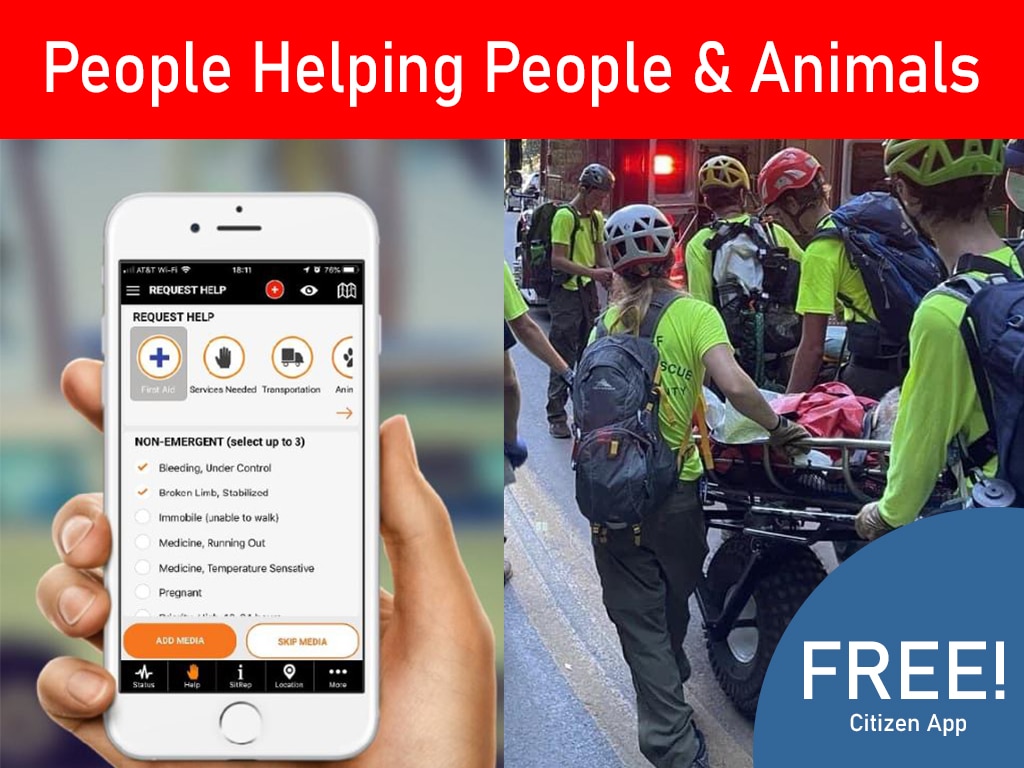
Contact PubSafe to discuss how the free PubSafe SOS mobile app or the Search Party Team Manager can bring rapid communication to your business.
What should a senior living emergency evacuation plan cover?
A senior living emergency evacuation plan should connect facility-specific risk assessment with resident needs, staff responsibilities, movement routes, transportation, receiving locations, accountability, communications, and care continuity. It should be written for the building and population it serves, then reviewed with local emergency management, fire officials, applicable regulators, and professional advisors.
Core elements of a facility-level evacuation plan
| Plan element | What to define | Why it matters in senior living |
|---|---|---|
| Risk and triggers | Hazards most likely to affect the facility, decision authority, evacuation triggers, and shelter-in-place alternatives. | An all-hazards assessment focuses preparation on emergencies that pose the greatest local and facility-specific risk. Review the source guidance and adapt it to the applicable jurisdiction. |
| Resident needs | Mobility, cognition, communication, medical support, equipment, medications, supervision, and assistance assignments for each resident. | Residents may not move, hear, understand, or tolerate disruption in the same way. See these senior-specific evacuation and mobility needs. |
| Operations and continuity | Floor or wing coverage, alternate staff, accessible routes, vehicles, supplies, receiving sites, rosters, family updates, and care handoffs. | Evacuation is not complete when residents leave the building. The facility must maintain accountability and coordinate support before, during, and after relocation. |
Keep the plan distinct from a household checklist. A facility must coordinate many residents, shifts, visitors, vendors, responders, and responsible parties at once. Update it when resident needs, staffing, routes, equipment, or the facility layout changes.
How should leaders assign evacuation roles and decision authority?
Assign one accountable incident lead, define each operational role in writing, and name a trained backup for every position. A senior living emergency evacuation plan should make clear who can activate the plan. Who directs movement, who protects continuity of care, and who reports status to local officials. Facility leadership and applicable local authorities govern those decisions. Validate the written plan with emergency management, fire officials, regulators, and professional advisers for the facility’s jurisdiction.
Name the incident lead and decision chain
The administrator, executive director, or another designated leader should serve as incident lead, with an alternate who can assume authority across every shift. The plan should distinguish evacuation from shelter-in-place. Shelter-in-place limits movement to protect residents, staff, and visitors from a hazard, while evacuation moves people away from danger. The appropriate action depends on the hazard, building conditions, staffing, resident needs, and official instructions. Some guidance recommends sheltering in place unless evacuation is mandated, but facilities must confirm how that principle applies locally rather than treating it as universal law.
Turn resident needs into named assignments
Designate a coordinator for each floor or wing, plus backups for nights, weekends, and staffing shortages. Give staff resident-specific assignments for people with limited mobility, cognitive impairment, medical conditions, oxygen, or other equipment needs. The assignment should identify the assistance required, the safest movement method, and who confirms completion. Review those assignments whenever residents, staffing, or the building layout changes.
- Clinical and resident-care lead: protects medication, treatment, documentation, and care continuity.
- Transport lead: confirms vehicles, drivers, accessible capacity, staging, and equipment movement.
- Accountability lead: maintains current rosters and checks residents at rooms, assembly areas, vehicles, and the receiving site.
- Communications lead: sends verified updates to staff, families, responders, and responsible parties through approved channels.
- Supply and records lead: moves essential supplies, identification, care information, and equipment.
- Receiving-site liaison: confirms space, intake procedures, resident arrivals, and handoffs at the destination.
Train every staff member on the emergency plan and their responsibilities upon hire and annually thereafter. Practice the backup chain during exercises so authority does not depend on one individual being present. Local requirements may add duties or documentation, so treat these assignments as an operational framework, not legal advice.
How do routes and transportation support resident needs?
Evacuation movement should be planned around the resident, not an assumed average traveler. Mobility limitations, cognitive impairment, medical conditions, anxiety, and reliance on equipment can change how quickly and safely someone moves. A useful plan translates each resident’s needs into route choices, assistance assignments, transportation capacity, and supplies. For additional context, review these accessible evacuation routes and transportation planning considerations.
- Map primary and alternate routes. Mark exits, stairwells, elevators, assembly areas, loading zones, and areas where residents can wait for assistance. Do not assume an elevator will be available during every incident. Identify an alternate path if a primary corridor, doorway, stairwell, or exterior access point is blocked. Walk both routes with the people and mobility devices expected to use them, then update the maps when the facility layout or resident population changes. Facility maps with clearly marked exits and alternative paths are core planning elements, but exact route decisions should be validated with local fire officials and other applicable authorities. Review facility evacuation route guidance.
- Match assistance to individual needs. Record who uses a wheelchair, walker, cane, oxygen, powered equipment, or other assistive device, and document the level of help required. Account for residents who may become disoriented or anxious under stress. Assign trained staff or other approved helpers to specific residents, floors, or wings, with backups for every shift. Keep the assignment usable during a phased evacuation as well as a full-building move.
- Plan vehicles, vendors, and staging. Confirm which accessible vehicles are available, who can drive them, how many residents and mobility devices each can carry, and where vehicles will stage without obstructing emergency access. Include contracted transportation providers, receiving-site contacts, and equipment vendors in the plan. Verify call procedures and backup contacts rather than relying on an informal promise of availability.
- Move care supplies with the resident. Coordinate medications, mobility aids, oxygen or other medical equipment, personal records, clothing, food, water, and charging or power needs with the responsible clinical and operational teams. The plan should identify who collects, labels, loads, and hands off these items. Guidance for adult-care facilities includes transportation, medications, meals, safety checks, and related continuity needs, but facilities should confirm quantities and procedures with clinicians, regulators, and local authorities. Use the family evacuation plan foundation for general meeting-point and reunification concepts, then adapt them to resident care and facility accountability.
How should a community choose receiving sites and preserve care?
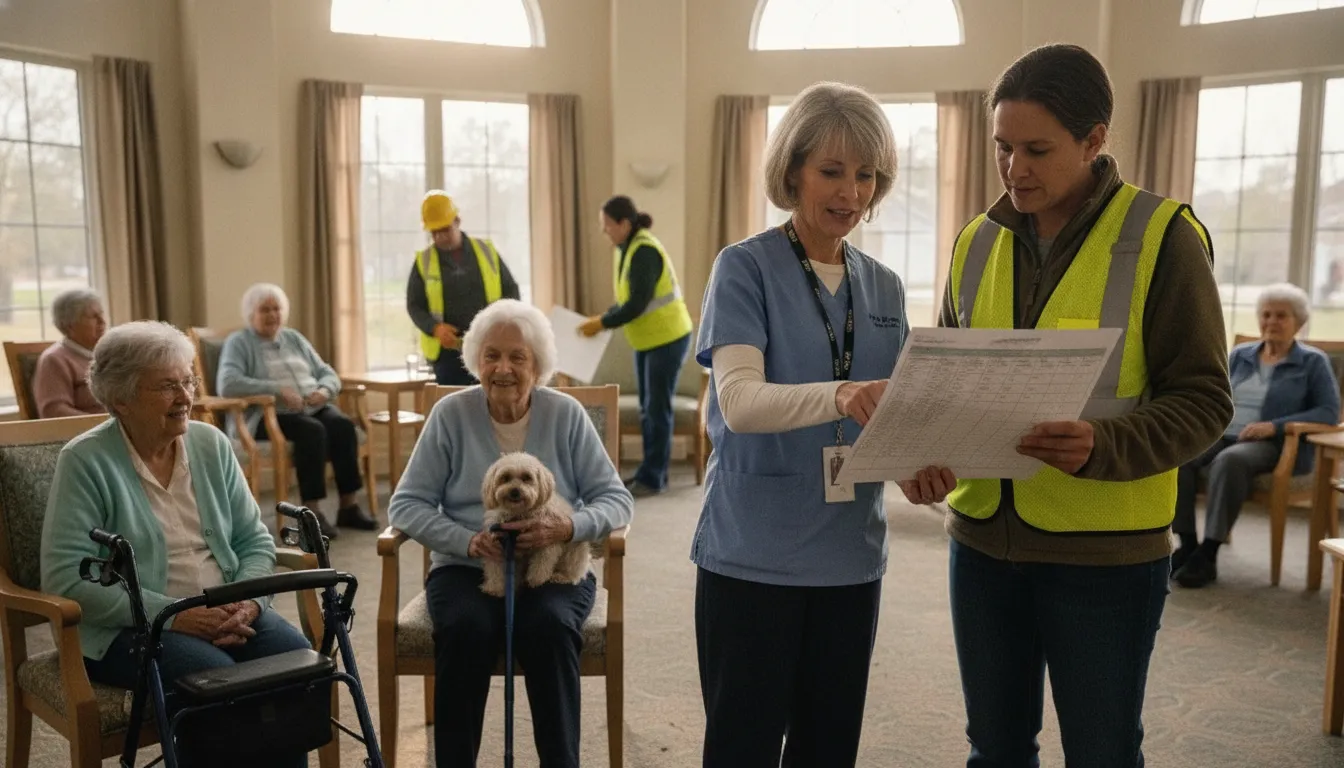
A receiving site is more than an address on an evacuation map. It must be able to support each resident’s care needs for the expected duration, with a clear process for arrival, medication management, meals, privacy, staffing, and eventual return. Treat destination planning as a care-continuity decision, not simply a transportation decision.
Evaluate a primary site and a backup site
Assess each destination with facility leaders, clinical partners, transportation providers, and local emergency officials. Confirm the site’s capacity, accessibility, power and water arrangements, sleeping spaces, bathrooms, food service. Temperature control, privacy, and ability to accommodate wheelchairs, oxygen, mobility aids, dementia-related needs, and other resident-specific requirements. Measure realistic travel time under emergency conditions, including loading, staging, traffic, and accessible vehicle availability.
Choose a backup site that is operationally different from the primary site. A second building in the same hazard area may not provide meaningful resilience. Document who can authorize the switch, who contacts the receiving site, and how staff will communicate the change to drivers, residents, families, and responders.
For adult-care facilities, North Carolina guidance gives a useful example by treating a public emergency shelter as a last resort rather than a primary destination. That is not a universal rule for every facility or jurisdiction, but it reinforces the need to prearrange destinations that can support resident care. Validate applicable requirements with regulators and local authorities.
Plan the handoff before residents arrive
Prepare a resident-by-resident transfer packet or approved electronic record with identification, care level, medications, allergies, dietary needs, mobility and communication requirements, emergency contacts, and current care instructions. Protect private information and share only what the receiving team needs to provide care. Assign staff to verify medication continuity, meals, hydration, safety checks, documentation, and resident location at arrival.
Use a sign-in process that records the resident, accompanying staff, vehicle or transport group, destination space, and receiving caregiver. Establish how families or authorized representatives will be verified before any handoff. A senior-specific plan should translate senior-specific evacuation and mobility needs into these documented assignments, rather than relying on memory during a crisis.
Finally, define return authority. Identify who confirms that the original facility is safe, who communicates the decision, and how residents, medications, records, transportation, and services will be transferred back without losing accountability.
How do facilities track residents and manage reunification?
Accountability is a repeated process, not a single headcount at the assembly area. Build the workflow around a current resident roster, with several working copies available to designated accountability staff. Guidance for adult-care facilities specifically recommends making several copies of the current roster. This allows the same resident record to travel with floor teams, transportation staff, and the receiving-site lead. Review the roster guidance alongside your facility’s privacy and record-handling procedures.
Use checkpoints that follow the resident
Record status at each meaningful handoff:
- Room or wing: Mark who has been located, who needs assistance, and who is still being checked. Floor or wing staff should report unresolved names immediately rather than waiting for the full building count.
- Assembly area: Reconcile the room-level list with residents physically present. Note residents who are separated from their usual group, require a mobility device, or need clinical support.
- Vehicle and departure: Record the vehicle, driver or transport team, accompanying staff, departure time, and destination for every resident. Do not rely on a vehicle manifest that lacks resident names.
- Receiving site: Repeat the count on arrival, then confirm the resident’s assigned area and care needs. The destination record should remain current if the resident moves again.
- Handoff: Document the authorized person receiving the resident, the time, and the staff member who verified the handoff.
Separate staff accountability from resident accountability
Staff should have their own roster and check-in process. A resident count can appear complete while a nurse, aide, driver, contractor, or supervisor is missing. Assign one person to reconcile resident status and another to reconcile staff status when staffing allows. If a name cannot be confirmed, escalate through the incident lead, floor or wing coordinator, and appropriate emergency authorities. Do not send untrained personnel into an unsafe area to search; follow the facility’s emergency procedures and official direction.
Reunification should be controlled, not handled through an informal request at the door. Verify the resident’s identity and the representative’s authorization, share only information permitted by policy, document the release, and notify the receiving-site lead. PubSafe can support shared coordination, status reporting, and messages between authorized teams. But it requires internet connectivity and does not replace 911, emergency responders, facility leadership, or official reunification procedures.
How should the facility communicate during an evacuation?
Communication should be treated as an operational assignment, not an informal task added after the evacuation begins. Residents, staff, families, emergency responders, transportation providers, receiving sites, and facility leadership each need timely information that matches their role. Name a communications lead and a backup, then define who approves messages, who sends them. And who confirms that each floor, wing, vehicle, and receiving location received the update.
Start with a verified contact list. Review resident responsible-party names, phone numbers, email addresses, preferred languages, accessibility needs, staff contacts, transportation providers, receiving-site contacts, and local response partners. Emergency phone numbers should remain current and accurate, and responsible parties should be told whether the facility plans to evacuate or shelter in place. See this emergency communication plan template for a framework covering message ownership, contact trees, confirmation, and fallback channels.
Use clear messages across primary and backup channels
Each message should state what happened, what action is required, where people should go, when the next update will arrive, and where verified information will be posted. Use plain language and provide accessible formats for residents who have hearing, vision, cognitive, language, or technology-access needs. Combine appropriate channels such as voice announcements, direct calls, text messages, email, visual notices, and staff-delivered instructions. Multi-channel emergency alerts for residents help reduce dependence on a single warning method.
Keep a primary channel and documented fallbacks. A power, cellular, or internet disruption may prevent app, email, or text delivery. So the facility should define procedures for runners, radios, posted notices, in-person room checks, and coordination with responders where appropriate. Do not assume a cloud platform will communicate during an outage without working connectivity. Record which messages were sent, which were confirmed, and which people still need direct contact.
How should a community test and improve the plan?
A plan is only useful when staff can apply it under pressure. Start with a tabletop exercise that walks leaders through a realistic scenario, such as a nighttime fire alarm, severe weather warning, or utility failure. Ask each role to explain what happens next, who makes the decision, how residents are prioritized, and how information reaches families, responders, and a receiving site.
Test the plan across real operating conditions
Do not limit testing to a weekday daytime shift. Run call-tree tests during day, night, and weekend coverage so you can identify gaps in staffing, contact information, transportation, or decision authority. Walk primary and alternate routes with staff. Check staging areas, elevators or stair contingencies, vehicles, vendor contacts, medication processes, and the equipment needed by residents with mobility or medical support needs.
Include community drills and training programs where practical. Outside partners can expose coordination problems that an internal discussion will miss, including unclear handoffs, blocked access points, or conflicting instructions. Keep exercises controlled and resident-centered. Follow the facility’s safety procedures, notify participants clearly, and coordinate with local emergency management and fire officials as appropriate.
Turn every exercise into a documented correction
After each test, hold an after-action review while details are fresh. Record what worked, what failed, which residents or shifts were not covered, and who owns each correction. Give every action a due date. A useful review may lead to a revised call tree, a new transportation backup, a clearer assembly-area roster, or additional training for a specific role.
Review the emergency preparedness plan at least annually and update it as needed. Staff should receive plan training upon hire and annually thereafter, according to the cited North Carolina adult-care preparedness material. Treat that schedule as a baseline to verify against the requirements that apply to your facility. Update sooner when residents’ needs, staffing, vendors, hazards, or the building layout change.
Facilities should validate their procedures with applicable regulators, local authorities, and professional advisors.
Frequently Asked Questions
What staff roles should be included in an evacuation plan?
Assign an incident lead and backup, resident-care and nursing coordinators, floor or wing leads, transportation and supply handlers, accountability staff, a family-communications lead, and a receiving-site liaison. Document each responsibility, succession coverage, and role-specific training. The CMS emergency preparedness sample guide provides a useful planning reference.
How do communities account for every resident during an evacuation?
Use a current resident-by-resident roster and check it at rooms, assembly areas, vehicles, and the receiving location. Record each resident’s destination and arrival, identify missing residents quickly, and track accompanying staff. Keep multiple copies of the current roster, as recommended in this North Carolina emergency preparedness guide.
What transportation should the plan include?
Prearrange primary and backup providers, accessible vehicles, drivers, pickup points, staging areas, route options, and vehicle capacity. Document wheelchair, oxygen, medication, medical-equipment, and supervision needs, then establish a process for tracking residents while in transit. Review these arrangements whenever resident needs or facility operations change.
How should a community communicate with families during an evacuation?
Keep resident and responsible-party contact information accurate, name a communications lead, and define primary and backup channels. Provide verified updates about the emergency, destination, and approved care information when permitted. Use accessible formats and protect resident privacy. Facilities should also verify requirements with applicable regulators and local emergency-management officials.
When should a community shelter in place instead of evacuating?
Base the decision on the hazard, official instructions, building safety, resident acuity, staffing, utilities, supplies, communications, and the facility’s ability to maintain care. Define who has decision authority and identify safe shelter areas and minimum self-sufficiency needs. Requirements vary by facility type and jurisdiction, so confirm the plan with local authorities and professional advisors.
Contact us to strengthen emergency coordination
A clear evacuation process depends on connected teams, accurate incident reporting, and communication that supports leaders during a fast-changing event. PubSafe can help you discuss how those coordination needs fit your senior-care operation, without replacing your facility’s official emergency plan, responders, or clinical authority. To talk through your priorities, Contact PubSafe and explore a practical next step for your team.